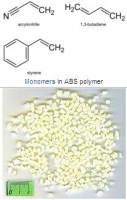
结构 ABS树脂是丙烯腈(Acrylonitrile)、1,3-丁二烯(Butadiene)、苯乙烯(Styrene)三种单体的接枝共聚物。它的分子式可以写为(C8H8)x·(C4H6)y·(C3H3N)z,但实际上往往是含丁二烯的接枝共聚物与丙烯腈-苯乙烯共聚物的混合物,其中,丙烯腈占15%~35%,丁二烯占5%~30%,苯乙烯占40%~60%,最常见的比例是A:B:S=20:30:50,此时ABS树脂熔点为175℃。 性质 ABS树脂是微黄色固体,有一定的韧性,密度约为1.04~1.06 g/cm3。它抗酸、碱、盐的腐蚀能力比较强,也可在一定程度上耐受有机溶剂溶解。 ABS树脂可以在-25℃~60℃的环境下表现正常,而且有很好的成型性,加工出的产品表面光洁,易于染色和电镀。因此它可以被用于家电外壳、玩具等日常用品。常见的乐高积木就是ABS制品。 ABS树脂可与多种树脂配混成共混物,如PC/ABS、ABS/PVC、PA/ABS、PBT/ABS等,产生新性能和新的应用领域,如:将ABS树脂和PMMA混合,可制造出透明ABS树脂。 当共混的三种成分比例的调整时,树脂的物理性能会有一定的变化: 1,3-丁二烯为ABS树脂提供低温延展性和抗冲击性,但是过多的丁二烯会降低树脂的硬度、光泽及流动性; 丙烯腈为ABS树脂提供硬度、耐热性、耐酸碱盐等化学腐蚀的性质; 苯乙烯为ABS树脂提供硬度、加工的流动性及产品表面的光洁度。 结构、性质和应用 在ABS树脂中,橡胶颗粒呈分散相,分散于SAN树脂连续相中。当受冲击时,交联的橡胶颗粒承受并吸收这种能量,使应力分散,从而阻止裂口发展,以此提高抗撕性能。 接枝共聚合的目的在于改进橡胶粒表面与树脂相的兼容性和粘合力。这与游离 SAN树脂的多少和接枝在橡胶主链上的 SAN树脂组成有关。这两种树脂中丙烯腈含量之差不宜太大,否则兼容性不好,会导致橡胶与树脂界面的龟裂。 ABS树脂可用注塑、挤出、真空、吹塑及辊压等成型法加工为塑料,还可用机械、粘合、涂层、真空蒸着等法进行二次加工。由于其综合性能优良,用途比较广泛,主要用作工程材料,也可用于家庭生活用具。由于其耐油和耐酸、碱、盐及化学试剂等性能良好,并具有可电镀性,镀上金属层后有光泽好、比重轻、价格低等优点,可用来代替某些金属。还可合成自熄型和耐热型等许多品种,以适应各种用途。 用途 适用于家用电器制品,如电视机外壳、冰箱内衬、吸尘器等,以及仪表、电话、汽车工业用塑料制品。 Acrylonitrile butadiene styrene (ABS) (chemical formula (C8H8)x· (C4H6)y·(C3H3N)z) is a common thermoplastic. Its glass transition temperature (ABS is amorphous and therefore has no true melting point) is approximately 105 °C (221 °F).
It is a copolymer made by polymerizing styrene and acrylonitrile in the presence of polybutadiene. The proportions can vary from 15 to 35% acrylonitrile, 5 to 30% butadiene and 40 to 60% styrene. The result is a long chain of polybutadiene criss-crossed with shorter chains of poly(styrene-co-acrylonitrile). The nitrile groups from neighboring chains, being polar, attract each other and bind the chains together, making ABS stronger than pure polystyrene. The styrene gives the plastic a shiny, impervious surface. The butadiene, a rubbery substance, provides resilience even at low temperatures. For the majority of applications, ABS can be used between −20 and 80 °C (-4 and 176 °F) as its mechanical properties vary with temperature. The properties are created by rubber toughening, where fine particles of elastomer are distributed throughout the rigid matrix.
Production of 1 kg of ABS requires the equivalent of about 2 kg of petroleum for raw materials and energy. It can also be recycled.
ABS plastic is damaged by sunlight. This caused one of the most widespread and expensive automobile recalls in US history.
Molecular formula (C8H8·C4H6·C3H3N)n CAS number 9003-56-9 Y ChemSpider 23143