微门户信息 |
| 统计 | 2 会员 873 新闻 0 讨论 0 行业报告 0 求职招聘 0 博客 |
| 打开网站 | http://360guanxi.com/group/1116/ |
| 简介 | 中文名称:尿素
英文名称:urea
其他名称:脲
定义:人体或其他哺乳动物中含氮物质代谢的主要最终产物,由氨与二氧化碳通过鸟氨酸循环而缩合生成,主要随尿排出。 应用学科:生物化学与分子生物学(一级学科);新陈代谢(二级学科)
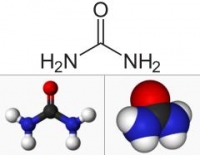
化学式:CO(NH2)2,
分子质量60.06 ,CO(NH2)2无色或白色针状或棒状结晶体,工业或农业品为白色略带微红色固体颗粒,无臭无味。含氮量约为46.67%。
密度1.335g/cm3。
熔点132.7℃。溶于水、醇,不溶于乙醚、氯仿。呈弱碱性。
CAS No.:57-13-6
EINECS号:200-315-5
分子式:CH4N2O
分子量:60.05
熔点:131-135℃
沸点:196.6°Cat760mmHg
折射率:n20/D 1.40
闪光点:72.7°C
Inchi:InChI=1/CH4N2O/c2-1(3)4/h(H4,2,3,4)
密度:1.335
水溶性:1080 g/L (20℃)
化学性质
可与酸作用生成盐。有水解作用。在高温下可进行缩合反应,生成缩二脲、缩三脲和三聚氰酸。加热至160℃分解,产生氨气同时变为氰酸。因为在人尿中含有这种物质,所以取名尿素。尿素含氮(N)46%,是固体氮肥中含氮量最高的。
尿素在酸、碱、酶作用下(酸、碱需加热)能水解生成氨和二氧化碳。
对热不稳定,加热至150~160℃将脱氨成缩二脲。若迅速加热将脱氨而三聚成六元环化合物三聚氰酸。(机理:先脱氨生成异氰酸(HN=C=O),再三聚。)
与乙酰氯或乙酸酐作用可生成乙酰脲与二乙酰脲。
在乙醇钠作用下与丙二酸二乙酯反应生成丙二酰脲(又称巴比妥酸,因其有一定酸性)。
在氨水等碱性催化剂作用下能与甲醛反应,缩聚成脲醛树脂。
与水合肼作用生成氨基脲。
尿素易溶于水,在20℃时100毫升水中可溶解105克,水溶液呈中性反应。尿素产品有两种。结晶尿素呈白色针状或棱柱状晶形,吸湿性强。粒状尿素为粒径1~2毫米的半透明粒子,外观光洁,吸湿性有明显改善。20℃时临界吸湿点为相对湿度80%,但30℃时,临界吸湿点降至72.5%,故尿素要避免在盛夏潮湿气候下敞开存放。目前在尿素生产中加入石蜡等疏水物质,其吸湿性大大下降。
Urea or carbamide is an organic compound with the chemical formula CO(NH2)2. The molecule has two —NH2 groups joined by a carbonyl (C=O) functional group.
Urea serves an important role in the metabolism of nitrogen-containing compounds by animals and is the main nitrogen-containing substance in the urine of mammals. It is solid, colourless, and odorless (although the ammonia that it gives off in the presence of water, including water vapor in the air, has a strong odor). It is highly soluble in water and practically non-toxic (LD50 is 15 g/kg for rat). Dissolved in water, it is neither acidic nor alkaline. The body uses it in many processes, the most notable one being nitrogen excretion. Urea is widely used in fertilizers as a convenient source of nitrogen. Urea is also an important raw material for the chemical industry. The synthesis of this organic compound by Friedrich Wöhler in 1828 from an inorganic precursor was an important milestone in the development of organic chemistry, as it showed for the first time that a molecule found in living organisms could be synthesized in the lab without biological starting materials (thus contradicting a theory widely prevalent at one time, called vitalism).
The terms urea and carbamide are also used for a class of chemical compounds sharing the same functional group RR'N—CO—NRR', namely a carbonyl group attached to two organic amine residues. Examples include carbamide peroxide, allantoin, and hydantoin. Ureas are closely related to biurets and related in structure to amides, carbamates, carbodiimides, and thiocarbamides.
CAS number 57-13-6 Y
PubChem 1176
ChemSpider 1143 Y
UNII 8W8T17847W Y
DrugBank DB03904
KEGG D00023 Y
ChEBI CHEBI:16199 Y
ChEMBL CHEMBL985 Y
RTECS number YR6250000
ATC code B05BC02,D02AE01
Uses[edit] AgricultureMore than 90% of world production of urea is destined for use as a nitrogen-release fertilizer. Urea has the highest nitrogen content of all solid nitrogenous fertilizers in common use. Therefore, it has the lowest transportation costs per unit of nitrogen nutrient. The standard crop-nutrient rating of urea is 46-0-0.
Many soil bacteria possess the enzyme urease, which catalyzes the conversion of the urea molecule to two ammonia molecules and one carbon dioxide molecule, thus urea fertilizers are very rapidly transformed to the ammonium form in soils. Among soil bacteria known to carry urease, some ammonia-oxidizing bacteria (AOB), such as species of Nitrosomonas, are also able to assimilate the carbon dioxide released by the reaction to make biomass via the Calvin Cycle, and harvest energy by oxidizing ammonia (the other product of urease) to nitrite, a process termed nitrification.[10] Nitrite-oxidizing bacteria, especially Nitrobacter, oxidize nitrite to nitrate, which is extremely mobile in soils and is a major cause of water pollution from agriculture. Ammonia and nitrate are readily absorbed by plants, and are the dominant sources of nitrogen for plant growth. Urea is also used in many multi-component solid fertilizer formulations. Urea is highly soluble in water and is, therefore, also very suitable for use in fertilizer solutions (in combination with ammonium nitrate: UAN), e.g., in 'foliar feed' fertilizers. For fertilizer use, granules are preferred over prills because of their narrower particle size distribution, which is an advantage for mechanical application.
The most common impurity of synthetic urea is biuret, which impairs plant growth.
Urea is usually spread at rates of between 40 and 300 kg/ha but rates vary. Smaller applications incur lower losses due to leaching. During summer, urea is often spread just before or during rain to minimize losses from volatilization (process wherein nitrogen is lost to the atmosphere as ammonia gas). Urea is not compatible with other fertilizers.
Because of the high nitrogen concentration in urea, it is very important to achieve an even spread. The application equipment must be correctly calibrated and properly used. Drilling must not occur on contact with or close to seed, due to the risk of germination damage. Urea dissolves in water for application as a spray or through irrigation systems.
In grain and cotton crops, urea is often applied at the time of the last cultivation before planting. In high rainfall areas and on sandy soils (where nitrogen can be lost through leaching) and where good in-season rainfall is expected, urea can be side- or top-dressed during the growing season. Top-dressing is also popular on pasture and forage crops. In cultivating sugarcane, urea is side-dressed after planting, and applied to each ratoon crop.
In irrigated crops, urea can be applied dry to the soil, or dissolved and applied through the irrigation water. Urea will dissolve in its own weight in water, but it becomes increasingly difficult to dissolve as the concentration increases. Dissolving urea in water is endothermic, causing the temperature of the solution to fall when urea dissolves.
As a practical guide, when preparing urea solutions for fertigation (injection into irrigation lines), dissolve no more than 30 kg urea per 100 L water.
In foliar sprays, urea concentrations of 0.5% – 2.0% are often used in horticultural crops. Low-biuret grades of urea are often indicated.
Urea absorbs moisture from the atmosphere and therefore is typically stored either in closed/sealed bags on pallets or, if stored in bulk, under cover with a tarpaulin. As with most solid fertilizers, storage in a cool, dry, well-ventilated area is recommended.
|
| 分类 |
微门户 |
|
|
|
|
|
|
|
 王晗先生
王晗先生
市场经理
明桥贸易(上海)有限公司
|
|
|
|